When Space Feels Like a Limitation
Many people assume that luxury design requires large rooms and expansive layouts.
When space is limited, the expectation often becomes practicality rather than elegance. The focus shifts to fitting everything in rather than creating a refined environment.
But thoughtful design challenges that assumption.
Luxury is not defined by square footage. It is defined by intention. When every element of a space is selected carefully, even the most compact home can feel sophisticated, comfortable, and beautifully balanced.
The key lies in designing with purpose rather than simply filling space.
Why Smaller Spaces Require More Intentional Design
Large spaces often allow for flexibility. There is room for adjustment when furniture placement or styling decisions are not perfectly aligned.
Smaller spaces do not offer the same margin for error.
Every piece of furniture affects movement. Every decorative element influences how open or crowded a room feels. Without thoughtful planning, compact spaces can quickly become cluttered or visually overwhelming.
This is why successful small-space design focuses on clarity.
Furniture should serve a purpose. Layouts should support movement. Decorative elements should enhance the atmosphere without competing for attention.
When these principles are applied consistently, smaller homes begin to feel curated rather than constrained.
Designing for Function Without Losing Elegance
One of the biggest challenges in compact homes is balancing function and style.
Practical solutions often focus solely on storage and efficiency. While these elements are essential, design should not lose its sense of beauty in the process.
Functional furniture can still feel refined. Storage solutions can blend seamlessly into the room’s aesthetic. Multi-purpose pieces can enhance the design rather than disrupt it.
A well-designed compact home demonstrates that practicality and elegance can coexist.
The goal is not simply to make the space work. It is to make the space feel intentional.
Creating the Illusion of Space
Design techniques can significantly influence how large a room appears.
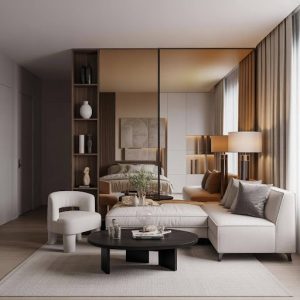
Light-coloured palettes often reflect natural light, making spaces feel brighter and more open. Mirrors create visual depth and make rooms feel larger than their physical dimensions.
Vertical design elements also play an important role. Tall shelving, elongated curtains, or vertical décor draw the eye upward, subtly expanding the perception of height within a room.
These techniques do not change the physical size of the space. But they dramatically change how the space is experienced.
Thoughtful design often works through perception as much as structure.
Choosing Quality Over Quantity
One of the most effective principles in small-space design is restraint.
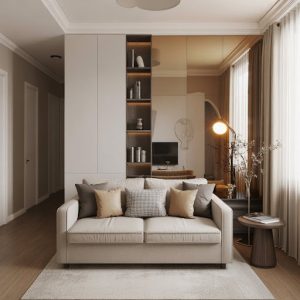
Rather than filling a room with multiple decorative elements, it is often more impactful to focus on fewer, higher-quality pieces.
A carefully chosen chair, an elegant light fixture, or a refined material can elevate an entire room.
This approach creates visual clarity while maintaining a sense of sophistication.
When every piece feels intentional, the space begins to communicate quiet luxury rather than crowded decoration.
When Small Spaces Become an Advantage
Compact homes often encourage a level of thoughtfulness that larger homes sometimes overlook.
Because space is limited, each design decision carries more weight. Every object must justify its presence. Every arrangement must serve a purpose.
This process naturally leads to more curated environments.
Instead of accumulating unnecessary elements, small homes often become carefully composed spaces where design feels purposeful and balanced.
In this way, limited space can become an unexpected advantage.
It invites creativity, discipline, and a deeper appreciation for thoughtful design.
Designing for Comfort, Not Just Appearance
While visual elegance matters, comfort remains the foundation of a successful home.
Small spaces should feel welcoming rather than restrictive. Furniture should support relaxation. Layouts should allow people to move freely without feeling confined.
When comfort and elegance work together, even compact homes feel expansive.
The space may be smaller, but the sense of calm, balance, and refinement becomes much larger.
The Quiet Power of Thoughtful Design
Ultimately, luxury in small spaces does not rely on dramatic gestures.
It appears in thoughtful layouts, refined materials, and carefully chosen details.
It appears in the ease people feel when they enter the room. In the way the space supports everyday living without feeling crowded or chaotic.
These qualities transform compact homes into environments that feel intentional, comfortable, and quietly sophisticated.
Luxury, after all, is rarely about size.
It is about the experience a space creates.